Bird Watching Safari in Tanzania and Kenya: 10 Stunning Birds to See

A bird watching safari in Africa shows you East Africa from a new angle: the flash of a lilac-breasted roller, a pink cloud of flamingos on a soda lake, a fish eagle calling over the water. Both countries are home to well over 1,000 bird species, from forest specialists to savannah giants, so every game drive and every lodge garden becomes a chance to find something new. Grand World Tours operates in Tanzania, Kenya and Zanzibar, and this guide explains where to go, the best time to travel, what to expect and 10 stunning birds to see.
Bird watching safari in Tanzania and Kenya with a lilac-breasted roller perched on an acacia branch

In this guide

What Is a Bird Watching Safari in Tanzania and Kenya?

A bird watching safari is a wildlife journey planned around birds. You still enjoy game drives and comfortable lodges, but your guide slows down, stops for a distant call and helps you find species that most visitors drive past. Time is spent at lakes, wetlands, forests and open plains, where different habitats bring different birds.

A bird watching safari in Tanzania and Kenya suits keen birders, beginners, photographers and families. You do not need to be an expert. Your guide identifies the birds, and a good pair of binoculars is all you need to get started.

Where to Go for a Bird Watching Safari in Tanzania and Kenya

Tanzania

•

Lake Manyara National Park: groundwater forest, an alkaline lake and a wide range of water birds, with flamingos and pelicans in season.

•

Tarangire National Park: baobab country with hornbills, bee-eaters, ground hornbills and many raptors.

•

Serengeti National Park: open plains with secretarybirds, bustards, ostriches and the lovebirds of the northern and central areas.

•

Arusha National Park: the Momella Lakes, forest and mountain scenery in a small, easy-to-reach park.

•

Usambara and Udzungwa Mountains: forest birds and regional specialities for dedicated birders, with longer travel times.

Kenya

•

Lake Nakuru National Park: famous for flamingos, pelicans and a rich mix of water and woodland birds.

•

Lake Baringo and Lake Naivasha: freshwater lakes with an excellent birding reputation, where boat trips bring you close to fish eagles and herons.

•

Maasai Mara National Reserve: raptors, vultures, cranes and plains birds beside the big game.

•

Samburu and the northern reserves: dry-country specials such as the vulturine guineafowl and the golden-breasted starling.

•

Kakamega Forest and Arabuko-Sokoke Forest: forest birds for those who want to go beyond the savannah.

Species and sites vary with the season, so we confirm the best places for your dates before we plan your itinerary.

Best Time for a Bird Watching Safari in Tanzania and Kenya

•

November to April: the best months for many birders. Migrants from Europe and Asia are present, and many resident birds are in breeding colour.

•

June to October: the dry season, with easy viewing, good roads and strong wildlife sightings, and fewer migrants.

•

March to May: the long rains, with lush scenery, fewer visitors and active breeding, though some roads are difficult.

Early morning is the best time of day, when birds are most active and the light is soft. Tell us which species you hope to see, and we will match your dates to the best season.

What to Expect on Your Bird Watching Safari in Tanzania and Kenya

1.

Early starts. You leave at dawn, when birdsong is at its peak and the air is cool.

2.

A guide who knows the calls. He or she identifies birds by sound and by the smallest movement in the bush.

3.

Slow drives and stops. The vehicle pauses for birds, not just for big game.

4.

Variety of habitats. Lakes, forests, plains and wetlands each bring different species.

5.

Boat trips and short walks where the park allows them, for closer views of water birds and forest species.

6.

Lodge gardens. Many lodges and camps are excellent for birds, so breakfast on the veranda can be a highlight.

7.

A checklist at the end of the day, to record what you have seen.

Top 10 Stunning Birds to See on a Bird Watching Safari in Tanzania and Kenya

1.

Lilac-breasted roller: a dazzling mix of lilac, turquoise and green, often seen on open branches.

2.

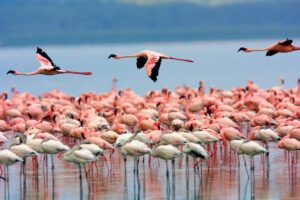
Lesser flamingo: huge pink flocks on the soda lakes, in seasons when conditions suit them.

3.

African fish eagle: a white-headed hunter with a famous, haunting call.

4.

Secretarybird: a long-legged raptor that hunts snakes on foot across the plains.

5.

Kori bustard: one of the heaviest flying birds in Africa, walking through the grassland.

6.

Grey crowned crane: an elegant bird with a golden crown, found near wetlands and grassland.

7.

Fischer’s lovebird: a small, bright green parrot with an orange face, a favourite in northern Tanzania.

8.

Golden-breasted starling: glowing gold and violet, a highlight of dry northern Kenya.

9.

Vulturine guineafowl: a striking blue and white bird with a long neck, found in the northern reserves.

10.

Hornbills: from the huge ground hornbill to the red-billed hornbill, they bring humour and character to every drive.

Sightings are never guaranteed, because birds move with the seasons and the weather. Part of the joy is the search.

Good to Know Before Your Bird Watching Safari in Tanzania and Kenya

•

Bring good binoculars: 8×42 or 10×42 binoculars suit most people. A field guide to East African birds is a helpful companion.

•

Camera and lens: a telephoto lens of 300mm or more helps for small and distant birds.

•

Dress in neutral colours: beige, olive and brown are less likely to scare birds than bright colours.

•

Respect the birds: keep your distance from nests, avoid flash photography and do not use recorded calls to lure birds, which can stress them.

•

Go slowly: birding rewards patience, so allow extra days at your best sites.

•

Tell us your target birds: we can shape the itinerary, the guide and the sites around them.

Why Pick Grand World Tours for Your Bird Watching Safari?

Grand World Tours is a Tanzania-based company operating in Tanzania, Kenya and Zanzibar, with trusted partners in Uganda, Namibia and South Africa. Our founder began as a professional safari guide, so we plan every bird watching safari in Tanzania and Kenya around real experience in the field.

•

Itineraries built around the best lakes, forests and plains for birds.

•

Guides who know bird calls and behaviour, and who share their knowledge.

•

Lodges and camps with good birding in their grounds.

•

A relaxed pace, with extra time at the places you love.

•

One team for Tanzania, Kenya and Zanzibar, with personal support before, during and after your trip.

For official information, visit Tanzania National Parks and the Kenya Wildlife Service. To learn about bird conservation, see BirdLife International.

Frequently Asked Questions About a Bird Watching Safari in Tanzania and Kenya

What is a bird watching safari?+

A bird watching safari is a wildlife trip planned around birds, with time at lakes, forests and plains, and a guide who helps you find and identify species.

How many bird species can we see?+

Both countries have well over 1,000 species. On a typical safari, many guests see 100 to 200 species, depending on the season, the route and the time spent birding.

What is the best time for a bird watching safari in Tanzania and Kenya?+

November to April is excellent, with migrants present and many birds in breeding colour. June to October is also good for easy viewing and big game.

Do we need to be experienced birders?+

No. Beginners are very welcome, and your guide will identify the birds and help you learn as you go.

Will we see flamingos?+

Often, but not always. Flamingo numbers change with water levels and the season, so we cannot promise them, but the lakes are beautiful in any case.

What should we bring?+

Binoculars, a field guide, a camera with a telephoto lens, a hat, sunscreen and neutral-coloured clothing. We can advise on the rest.

Can we combine birding with big game?+

Yes. Most of our guests do. A bird watching safari in Tanzania and Kenya works well alongside game drives, and can be added to family, photographic and honeymoon journeys.

How many days do we need?+

We suggest 7 to 10 days to cover several habitats in Tanzania and Kenya at a relaxed pace. Shorter trips can focus on one region.

Plan Your Bird Watching Safari in Tanzania and Kenya

Ready to start your bird watching safari in Tanzania and Kenya? Tell us your dates, your favourite birds and who is travelling, and we will design a journey full of colour and song.

Enquire about your bird watching safari today →

Our travel Journal