A Safari Encounter Like No Other
What Are the Big Five and Why Do They Matter?
There is a moment on every Tanzania safari when the conversation turns to the Big Five, and eyes around the game drive vehicle light up with a particular kind of anticipation. The term itself carries an almost mythological weight in the world of wildlife travel — five animals so powerful, so magnificent, and so deeply embedded in the story of African safari culture that encountering all of them on a single trip has become one of the most celebrated achievements in wildlife tourism anywhere on earth.
The Big Five — lion, leopard, elephant, buffalo, and rhinoceros — were originally named not for their size or their beauty, though both are extraordinary, but for the danger they posed to hunters on foot during the era of big-game hunting that shaped so much of East Africa’s colonial history. These were the five animals that were considered the most difficult and most dangerous to hunt on foot, the five that commanded the greatest respect, the greatest fear, and consequently the greatest prestige among those who pursued them. That dark chapter of Africa’s history has thankfully given way to a far more enlightened and enriching tradition — the wildlife safari — and the Big Five have been reborn as symbols not of conquest but of wonder, not of death but of the extraordinary, irreplaceable vitality of the natural world.
Tanzania is one of a very small number of destinations on earth where all five of these iconic animals can be encountered in the wild, often on the same game drive, and always in landscapes of such breathtaking grandeur that the setting itself becomes part of the experience. To complete the Big Five safari experience in Tanzania is to achieve something genuinely memorable — but the true value of these encounters lies not in the ticking of a checklist but in the profound, intimate, sometimes unsettling, always unforgettable connection that each animal offers with the wildest and most magnificent version of the natural world.
The Lion: King of the Serengeti
The Encounter
Nothing in the world of wildlife prepares you for your first truly close encounter with a wild lion. You may have seen lions on television, in documentaries filmed with the most sophisticated cameras available, narrated by voices of great authority and calm — and none of it will have prepared you for the reality. The sheer physical presence of a lion at close range, the absolute, unhurried confidence with which it regards your vehicle, the deep amber intelligence in those extraordinary eyes — it stops something inside you, quietly and completely, and you find yourself sitting in a silence that is not uncomfortable but deeply, profoundly respectful.
Lions are the most social of Africa’s big cats, living in family groups called prides that can range from a handful of individuals to large, extended families of twenty or more animals. On the open plains of the Serengeti, where the grass is short and the sight lines are long, lion sightings are remarkably consistent and extraordinarily rewarding. A pride of lions at rest in the early morning, sprawled across a rocky kopje with the golden light of dawn catching their manes, is one of the most painterly and perfect sights in all of Africa — a vision of power and beauty in complete, unhurried repose.
The Hunt
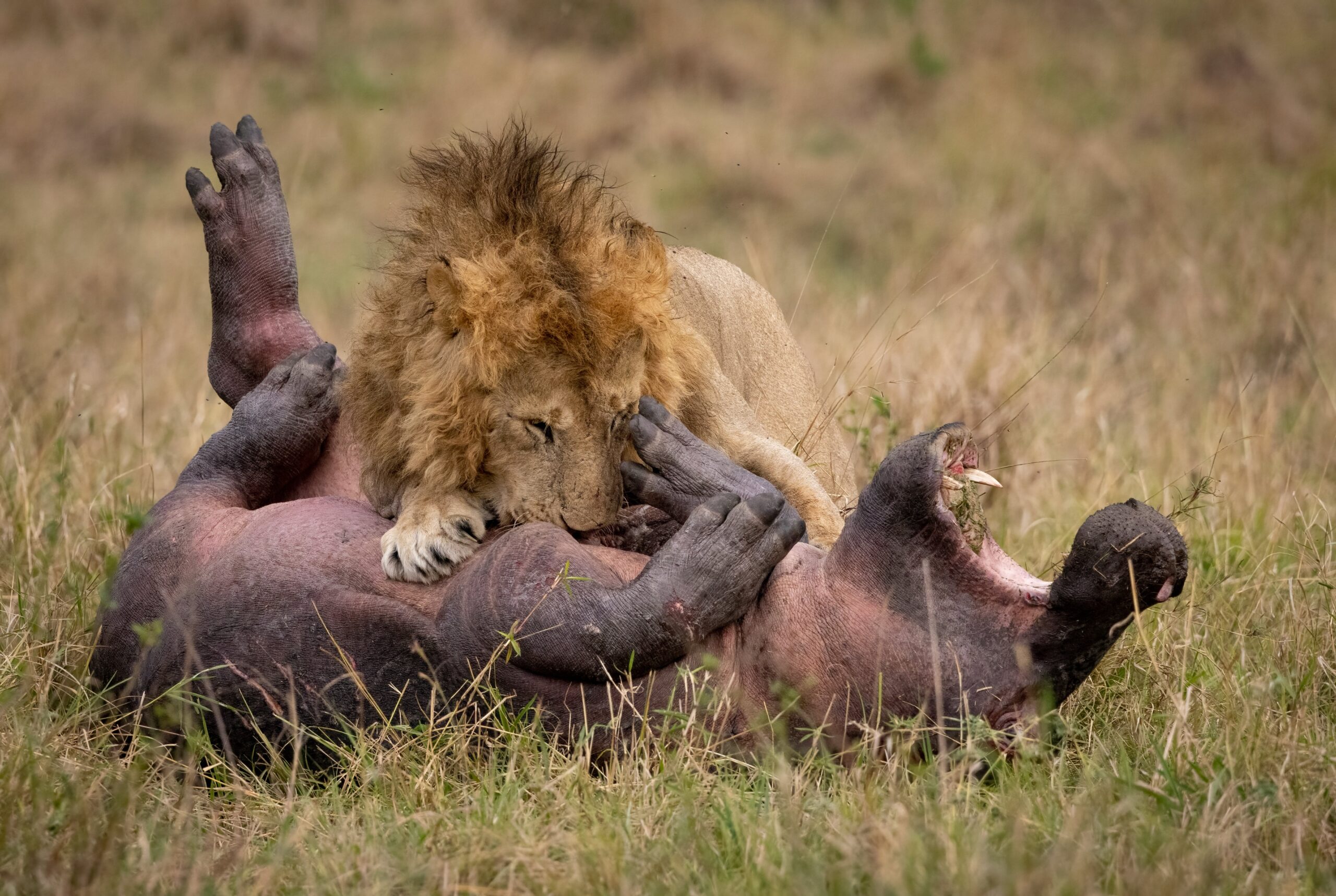
But it is the lion hunt that truly reveals the full, electric drama of these animals. Lions are primarily nocturnal hunters, which means that the best chances of witnessing a hunt come in the very early morning, when the night’s activity is at its most recent and prides are often still engaged in the final stages of a pursuit. Watching a pride of lions work together to bring down a wildebeest or a zebra on the open Serengeti plains — the coordinated approach, the explosion of speed and power, the extraordinary athleticism of the kill — is simultaneously one of the most visceral and one of the most humbling things a human being can witness in the natural world. It is life and death playing out with complete honesty and no sentiment, and it changes permanently the way you think about both.
The Serengeti National Park, the Ngorongoro Crater, and Tarangire National Park are among Tanzania’s finest destinations for lion sightings, with the Ngorongoro Crater in particular offering some of the most accessible and consistently rewarding lion encounters anywhere in Africa. The crater’s contained geography means that its resident lion prides are well known to guides and are encountered with remarkable regularity, often at distances so close that the sound of their breathing is clearly audible from the vehicle.
The Leopard: The Most Elusive and Breathtaking of the Big Five
The Secret Cat
If the lion is the king of the Serengeti, the leopard is its shadow — present everywhere, seen rarely, and more beautiful than almost anything else the African bush has to offer. Of all the Big Five, the leopard is widely regarded as the most difficult to find and the most breathtaking to encounter, and the combination of these two qualities — extreme elusiveness and extreme beauty — gives a leopard sighting a quality of electric, almost disbelieving joy that no other safari encounter quite matches.
Leopards are solitary, secretive, and magnificently adapted to invisibility. Their spotted coats dissolve into dappled light and shadow with an almost supernatural effectiveness, and their habit of resting in the dense canopy of acacia and sausage trees means that an animal of substantial size can be completely invisible to even experienced eyes until a tail dangles carelessly from a branch or a golden eye blinks in the shadows above. The moment your guide spots a leopard and points it out to you — initially invisible, then suddenly, startlingly, unmistakably there — produces a rush of adrenaline and disbelief that is one of the most purely exciting moments available on any Tanzania safari.
Where to Find Leopards in Tanzania
The Serengeti holds a healthy leopard population, and the riverine forests along the Seronera River in the central Serengeti are particularly famous for leopard sightings, with several well-known individuals regularly observed resting in favourite trees. Ruaha National Park in southern Tanzania is another outstanding leopard destination, with a high density of leopards and a wilderness character that makes sightings feel particularly intimate and unspoiled.
A leopard kill hoisted high into the fork of a tree — the animal’s remarkable strength demonstrated by the fact that it can carry prey heavier than itself vertically up a trunk — is one of the signature images of the African safari and one of the most sought-after photographic opportunities in Tanzania. If you are fortunate enough to find a leopard in a tree with a kill, your guide will know to stay close and patient, because the leopard may descend to feed, and the interaction between predator and prey, even after the hunt is complete, is one of extraordinary, complex drama.
The Elephant: Tanzania’s Gentle Giant
An Encounter That Touches the Soul
Of all the animals encountered on a Tanzania Big Five safari, it is perhaps the African elephant that leaves the deepest and most lasting emotional impression. There is something about elephants — their immense physical presence, their obvious intelligence, their complex social bonds, the extraordinary gentleness with which they interact with their young — that resonates with human observers at a level that goes beyond ordinary wildlife appreciation and enters the territory of genuine emotional kinship.
Tanzania is home to one of the largest elephant populations in Africa, with an estimated 60,000 to 70,000 elephants distributed across the country’s national parks and game reserves. Tarangire National Park is perhaps the finest single destination in Tanzania for elephant encounters, with the dry season bringing enormous herds of hundreds of animals to the banks of the Tarangire River — a concentration of elephant life so extraordinary that it has to be seen to be believed. The sight of a herd of two hundred elephants moving across the red-earthed landscape of Tarangire, the calves keeping close to their mothers’ sides while the matriarch leads with ancient, unhurried authority, is one that reduces even the most undemonstrative safari visitor to a state of quiet, grateful wonder.
Family Bonds and Elephant Intelligence
Spending time with a family group of wild elephants reveals the extraordinary depth and complexity of their social lives. Elephant families are led by an older female — the matriarch — whose decades of accumulated knowledge guide the group to water, food, and safety with a wisdom that has been demonstrated to be genuinely remarkable. When a family group encounters a watering hole after a long dry-season journey, the joy they express is unmistakable and deeply moving — calves splashing exuberantly in the shallows, adults drinking deeply and showering themselves with trunkfuls of water, the entire group vocalising in low rumbles of apparent contentment and relief.
The Amboseli ecosystem bordering Tanzania and Kenya, and the vast wilderness of the Selous Game Reserve — now the Nyerere National Park — in southern Tanzania also hold significant elephant populations and offer elephant encounters of exceptional quality. In Amboseli, bull elephants with extraordinary tusks move through the landscape with the snow-capped dome of Mount Kilimanjaro rising magnificently behind them — a photographic combination so iconic and so beautiful that it has come to represent the very essence of the East African wildlife experience.
The Buffalo: The Most Dangerous Member of the Big Five
Africa’s Most Unpredictable Animal
The African buffalo is the member of the Big Five that first-time safari visitors most consistently underestimate, and it is a mistake that experienced guides are quick and firm to correct. Of all the Big Five, the buffalo is statistically the most dangerous to humans on foot — more unpredictable than the lion, more aggressive when wounded or cornered than the leopard, and possessing a combination of physical power, speed, and what can only be described as a deeply bad temper that makes it one of the most formidable animals in Africa.
From the safety of a safari vehicle, however, the buffalo offers some of the most dramatic and visually compelling encounters of any Tanzania safari. Large buffalo herds on the open Serengeti plains can number in the thousands, moving across the landscape in a dark, slow-moving mass that creates a spectacle of almost prehistoric grandeur. The sound of a large herd on the move — the thunder of hooves, the constant lowing and grunting, the crack of horns knocking together — is deeply impressive and somehow ancient, a sound that connects you directly to a world that existed long before human beings arrived to complicate it.
Buffalo and Lions: Nature’s Greatest Rivalry
The relationship between buffalo and lions is one of the most dramatic and endlessly fascinating dynamics in the African ecosystem. Lions regularly hunt buffalo, targeting the young, the old, and the sick from the edges of herds, but buffalo are more than capable of defending themselves and each other with extraordinary ferocity. It is not uncommon to witness a scenario in which a lion that has brought down a buffalo is then charged by the rest of the herd, which will sometimes succeed in rescuing a stricken herd member and driving the lions away — a display of collective courage and solidarity that is genuinely astonishing and deeply moving to witness.
Old dugga boys — solitary or small-group bachelor bulls that have been pushed out of the main herd — are a particularly evocative sight in the African bush. Scarred, massive, and radiating a battle-hardened wariness, these old males carry themselves with a dignity and a dangerous authority that makes an encounter with one, even from a vehicle, feel genuinely charged with tension and respect.
The Rhinoceros: Tanzania’s Most Precious and Rarest Treasure
The Most Sacred Sighting of All
Of all the members of the Big Five, it is the black rhinoceros that inspires the deepest reverence and the most profound sense of privilege among safari visitors in Tanzania. This is the animal whose survival has hung most perilously in the balance, whose numbers have been decimated by decades of catastrophic poaching driven by the insatiable illegal demand for rhino horn in Asian markets, and whose presence in the wild today is a testament to extraordinary conservation efforts and enormous sacrifice by the rangers, conservationists, and communities who have fought and continue to fight for its survival.
Tanzania’s black rhino population is concentrated primarily within the Ngorongoro Crater, where an estimated 26 to 30 individuals are protected within the caldera under intensive conservation management. The number is heartbreakingly small — a remnant of a population that once ranged across vast areas of East Africa — but the rhinos of the Ngorongoro Crater are alive and, critically, reproducing, and each new calf born represents a small but enormously significant victory for conservation.
The Emotional Weight of a Rhino Sighting
Encountering a black rhino in the Ngorongoro Crater is an experience charged with an emotional weight that goes far beyond ordinary wildlife viewing. When you see one of these ancient, armoured, magnificently prehistoric creatures moving through the crater floor — often at considerable distance, a grey shadow moving through the golden grass — you are looking at one of the rarest and most endangered large mammals on earth. The knowledge of what has been done to this species, of how close it has come to extinction, and of how precarious its survival remains, gives every rhino sighting a quality of hushed, grateful reverence that is entirely unlike any other safari encounter.
Many visitors to the Ngorongoro Crater report that their rhino sighting — even a brief, distant glimpse of a grey shape moving through the crater floor — moved them to tears, not from sadness exactly, but from a complex mixture of wonder, relief, gratitude, and a fierce, protective love for something so ancient and so threatened and so irreplaceable. It is the Big Five sighting that means the most, not despite the distance or the brevity, but because of everything it represents about the fragility and the preciousness of wild life on this earth.
Completing the Big Five: The Safari Achievement of a Lifetime
Strategy and Patience
Successfully encountering all Big Five animals on a Tanzania safari requires a combination of careful planning, expert guiding, genuine patience, and a willingness to let the bush reveal itself on its own schedule. No reputable guide or operator will ever guarantee Big Five sightings — wildlife is wild, unpredictable, and magnificently indifferent to the expectations of visiting humans. But Tanzania’s extraordinary biodiversity and the skill of its best guides make completing the Big Five a realistic and achievable goal for most visitors who spend an adequate amount of time in the right parks.
The Ngorongoro Crater is statistically the single best location in Tanzania — and arguably in all of Africa — for completing the Big Five in the shortest time, precisely because its contained geography concentrates wildlife with extraordinary efficiency. Many visitors complete all five within a single long day in the crater, though the rhino sighting is never guaranteed and often requires patience, good fortune, and a guide with sharp eyes and deep local knowledge.
Beyond the Checklist
And yet the most important thing that any first-time Tanzania safari visitor can be told about the Big Five is this — the greatest gift of the pursuit is not the completion of the list, but everything that happens along the way. The Big Five framework gives structure and purpose to the safari experience, particularly for those encountering African wildlife for the first time, and the thrill of each successful sighting is genuine and deeply satisfying. But the encounters that lodge most permanently and most powerfully in the memory are often the ones that have nothing to do with the list at all — a tiny dung beetle rolling its ball across a dusty track, a family of warthogs trotting in single file with tails raised like small flags, a fish eagle calling over a silver lake at sunset, or an old elephant bull standing alone in the long grass, his immense sides heaving slowly in the afternoon heat, as ancient and as magnificent and as quietly moving as anything the African continent has ever produced.
Tanzania’s Big Five will dazzle you, thrill you, and leave marks on your memory that time will not erase. But it is Tanzania itself — the whole, magnificent, teeming, ancient, heartbreaking, life-affirming entirety of it — that will change you. That is the true experience. That is the real treasure. And it is waiting for you, patient and extraordinary, on the golden plains of the greatest safari destination on earth.