The complete Kilimanjaro packing list — everything you need for a successful summit
Climbing Mount Kilimanjaro is one of the most achievable and rewarding high-altitude adventures available to any fit and determined traveller. At 5,895 metres, it is the highest mountain in Africa — and yet it requires no ropes, no ice axes, and no technical mountaineering experience. What it does require is the right gear. Your clothing, boots, and equipment are not simply a matter of comfort on Kilimanjaro — they are a matter of safety. The mountain passes through five dramatically different climate zones in the course of a single climb, and temperatures can swing from a warm 25°C at the base to a brutal -15°C or colder on summit night. Prepare well, and the summit is within reach. Prepare poorly, and the mountain will turn you back. This guide covers everything you need to know.
Your gear is not a luxury on Kilimanjaro — it is your first line of defence against altitude, cold, rain, and wind. At Grand World Tours, we don’t just guide you up the mountain. We prepare you for it, step by step, from the moment you contact us to the moment you step onto Uhuru Peak.
One of the most extraordinary aspects of climbing Kilimanjaro is the sheer ecological variety the mountain passes through. In the course of five to nine days, a single climb takes you through five completely distinct climate zones — each with its own temperature range, weather patterns, and gear demands. Understanding what awaits you in each zone is the foundation of packing correctly.
Rainforest zone — 1,800m to 2,800m
Warm, humid, and dense with vegetation. Temperatures hover between 15°C and 25°C. Expect moisture — from rain, mist, and the dripping forest canopy — almost every afternoon. Light, moisture-wicking clothing and a rain jacket are essential from the very first day.
Heath & moorland — 2,800m to 4,000m
Cooler and often misty, with temperatures between 5°C and 15°C. The open moorland exposes trekkers to wind for the first time, and the temperature drops noticeably after sunset. Fleece layers become important from this zone upward.
Alpine desert — 4,000m to 5,000m
Dry, stark, and dramatically temperature-variable. Days can be surprisingly warm in direct sun, while nights plunge to -5°C or below. The altitude begins to have a noticeable effect on breathing and energy levels. Insulated layers and wind protection are critical here.
Arctic summit zone — 5,000m to 5,895m
Snow, ice, and temperatures that routinely fall to -15°C or colder on summit night. This is the zone that separates the prepared climber from the underprepared one. Every item of your summit kit — down jacket, waterproof shell, thermal gloves, balaclava — earns its place here, and not one of them is optional.
Experienced mountaineers and expedition guides worldwide rely on the three-layer clothing system, and Kilimanjaro is exactly where this approach proves its value. The principle is simple: three distinct layers work together to manage moisture, retain warmth, and protect against wind and rain. Each layer has a specific function, and together they allow you to adapt to the mountain’s rapidly changing conditions by adding or removing layers as needed throughout the day.
Base layer — moisture control
Your base layer sits directly against your skin and its sole purpose is to move sweat away from your body and keep you dry. Synthetic fabrics and merino wool are ideal. Cotton is absolutely prohibited — it absorbs moisture, stops insulating when wet, and in cold conditions at altitude can become genuinely dangerous. Pack two to three thermal tops, thermal leggings, and five to six moisture-wicking undergarments.
Mid layer — insulation
Your mid layer traps warm air close to your body and provides the bulk of your warmth. Two to three fleece jackets cover the lower and mid altitude sections of the climb. Your insulated down jacket — hooded, summit-ready, and rated for sub-zero temperatures — is the most important single garment in your pack and should be reserved for the upper mountain and summit night, when you will need every degree of warmth it provides.
Outer layer — protection
Your outer layer is your shield against wind, rain, and cold. A waterproof hard shell jacket made from Gore-Tex or an equivalent breathable membrane is the standard for serious mountain use — it blocks wind completely, sheds rain and snow, and allows body moisture to escape. Waterproof rain pants and wind-resistant summit trousers complete the outer layer. On summit night, with temperatures potentially below -15°C and a biting wind, this layer is the difference between reaching Uhuru Peak and turning back.
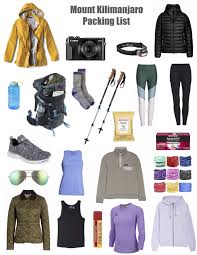
The following clothing items cover every stage of the climb from the rainforest gate to the glaciated summit. Each item has been selected for a specific function on the mountain — nothing on this list is unnecessary, and omitting any mandatory item risks your comfort and safety at altitude.
- Fleece jacket (Polartec or equivalent) — mandatory
- Insulated down jacket, hooded — mandatory
- Waterproof hard shell jacket (Gore-Tex) — mandatory
- Trekking pants (2 pairs) — mandatory
- Waterproof rain pants — mandatory
- Insulated summit pants — mandatory
- Thermal leggings (base layer)
- 3–4 short sleeve moisture-wicking shirts — mandatory
- 2–3 long sleeve thermal tops — mandatory
- 5–6 moisture-wicking undergarments
- Warm beanie hat — mandatory
- Sun hat or baseball cap — mandatory
- UV 400 mountain sunglasses — mandatory
- Headlamp (300+ lumens, extra batteries) — mandatory
- Balaclava (highly recommended)
- Neck gaiter / buff
Of all the gear choices you make for Kilimanjaro, your boots matter most. Blisters, ankle injuries, and cold, wet feet are among the most common reasons trekkers struggle or fail to reach the summit — and every one of these problems can be avoided with the right footwear, properly broken in before you arrive in Tanzania.
Your boots must be waterproof, must provide strong ankle support to handle the rocky, uneven terrain of the upper mountain, and must be medium-weight trekking boots rather than lightweight trail shoes. Most importantly, they must be thoroughly broken in — new boots on Kilimanjaro are an almost guaranteed source of severe blisters. Begin wearing your boots on long walks at home at least four to six weeks before your climb. Trusted and proven brands for Kilimanjaro include La Sportiva, Salomon, Scarpa, and Zamberlan, all of which produce boots specifically suited to this type of high-altitude trekking.
Bring four to five pairs of quality wool trekking socks and one to two pairs of thermal summit socks. As with your base layer clothing, never wear cotton socks on the mountain — cotton holds moisture and loses its insulating properties when wet, leading rapidly to cold feet and blisters. Gaiters are highly recommended during the rainy season to keep mud and debris out of your boots on the lower slopes.
You will carry two bags on Kilimanjaro: a daypack that stays with you throughout each day’s trekking, and a large duffle bag that your porter carries between camps. Each has specific requirements, and packing them correctly makes a significant difference to your daily comfort on the mountain.
- Rain cover — mandatory
- Hip belt for weight distribution — mandatory
- Side bottle pockets — mandatory
- Water, snacks, camera, rain jacket
- Gloves, headlamp, personal first aid
- Sunscreen, lip balm, hand sanitiser
- Maximum 15kg — park regulation
- Sleeping bag (rated to -20°C minimum)
- Sleeping mat or inflatable pad
- Extra clothing layers and spare gear
- Pack contents in waterproof dry bags
- Toiletries, medications, personal items
The 15 kilogram porter weight limit is a strict Kilimanjaro National Park regulation, enforced at every gate weigh-in. Exceeding it means leaving items behind at the start of your climb. Pack thoughtfully, weigh your duffle bag before departure, and always use waterproof dry bags inside your duffle — porters carry loads in all weather, and an unprotected sleeping bag that gets soaked at the rainforest stage can ruin the entire climb.
Altitude sickness is the single most significant medical risk on Kilimanjaro, and dehydration is one of the primary triggers. The recommendation from experienced mountain guides and altitude medicine specialists is to drink three to four litres of water every single day on the mountain — significantly more than most people drink in normal daily life at sea level. This is not a suggestion; it is a medical imperative that directly affects your summit success rate.
Carry at minimum two one-litre water bottles in your daypack’s side pockets for easy access throughout the day. A one-litre thermos flask is highly recommended for the upper mountain and summit night, where having hot water or a warm drink in sub-zero conditions makes a profound practical and psychological difference to the experience. A hydration bladder is a useful optional addition, allowing hands-free drinking during long ascent sections, though the drinking tube can freeze on summit night and should be used with caution above 5,000 metres.
Trekking poles are not compulsory on Kilimanjaro, but they are one of the most consistently useful pieces of equipment you can bring, and Grand World Tours strongly recommends them for all climbers regardless of fitness level or experience. The daily distances on the mountain — typically seven to ten kilometres of often rocky, uneven terrain — put significant strain on the knees, particularly on the long descents. Poles absorb a meaningful proportion of that impact, reducing knee fatigue and greatly improving balance on the loose scree of the upper mountain.
On the final summit push — a six to seven hour overnight ascent on steep, loose volcanic rock in the dark and the cold — poles provide essential stability at a moment when exhaustion and altitude are both working against you. Collapsible aluminium or carbon fibre poles with interchangeable baskets (wide snow baskets for the summit zone, narrower walking baskets for the lower trails) are the standard choice. If you prefer not to travel with poles, high-quality rental poles are available through Grand World Tours in Moshi.
If you prefer not to travel with the full weight and bulk of mountaineering gear, Grand World Tours offers a comprehensive equipment rental service in Moshi, at the base of Kilimanjaro. All rental gear is carefully inspected, cleaned, and mountain-tested before each use, and covers the full range of essential equipment — sleeping bags, trekking poles, down jackets, waterproof shells, gaiters, and more. Rental is an excellent option for first-time climbers, travellers with luggage restrictions, or those who want to try high-altitude trekking before investing in their own dedicated kit.
You do not need the most expensive gear on the market to climb Kilimanjaro. But you must avoid cheap, low-quality equipment that fails when it matters most. A waterproof jacket that lets rain through in the forest zone will leave you soaked and cold before you reach the moorland. Boots without proper ankle support will fail on the loose rock of the upper mountain. A sleeping bag rated only to 0°C will leave you shivering through summit night. Quality matters on Kilimanjaro — your gear is your safety system.
The distinction is between investing wisely and overspending unnecessarily. Mid-range gear from established outdoor brands — Salomon, Berghaus, Marmot, The North Face, Patagonia, or equivalent — performs excellently on Kilimanjaro without requiring the premium prices of professional expedition equipment. If you are unsure what to purchase, Grand World Tours provides a detailed, personalised gear consultation for every booked climber, advising on what to buy, what to borrow, and what to rent in Tanzania.
Professional certified mountain guides
Every Grand World Tours guide is KINAPA-certified, first-aid trained, and experienced in managing altitude-related conditions and emergency situations on the mountain.
High summit success rate
Our carefully designed itineraries prioritise acclimatisation above all else, giving every climber the maximum possible time to adjust to altitude and the best possible chance of reaching Uhuru Peak.
Personalised preparation support
From the moment you book, our team provides tailored guidance on gear, fitness preparation, route selection, and acclimatisation strategies — so you arrive in Tanzania ready in every sense.
Quality camping equipment
All camping equipment — tents, sleeping mats, dining facilities — is regularly inspected and maintained to a high standard. Your comfort between the summit push days is taken as seriously as the climb itself.
Your Kilimanjaro adventure starts with a single conversation
Preparation is not just about packing the right gear — it is about having the right team behind you. At Grand World Tours, we have guided hundreds of climbers from first enquiry to Uhuru Peak, and we understand that every trekker arrives with a different fitness level, a different set of questions, and a different vision of what standing on the Roof of Africa will mean to them. Our role is to close the gap between where you are now and where you want to be — on the summit, at dawn, with the whole of Africa spread out below you.
Contact our team today and we will help you choose the best route for your fitness and timeline, build your personalised gear checklist, arrange any equipment rentals you need, and design a customised climbing itinerary that gives you the highest possible chance of reaching the summit safely and memorably.
Grand World Tours — we don’t just guide you up the mountain. We prepare you for it.






%20copy%203.svg)